Textiles & home care
How Knit Structure Shapes the Warmth and Care of Cotton Throws
A cotton throw is more than a layer of color at the end of a bed or across the arm of a sofa. Its knit determines how it hangs, how much air it holds, how it feels against the skin—and how carefully it must be washed and stored.
Published November 17, 2026
The word “warmth” suggests a simple measurement: more or less. With a knitted cotton throw, the reality is subtler. A layer can feel warm because its fibers hold still air, because its stitches create a substantial surface, or because it is dense enough to sit close to the body. It can also feel light and breathable, a useful cover for a cool evening rather than a substitute for a heavy blanket. Fiber, yarn, stitch, weight, and construction all play a part.
That makes the knit pattern more than decoration. Ribbing, seed stitch, and variations in stitch height give a textile dimension, affect its drape, and influence how it responds to use. The same structure that makes a throw feel supple or textured can also make it more likely to stretch if it is pulled, hung, or washed without care. Understanding those connections turns shopping labels and laundry instructions into useful information rather than fine print.
What a knit does that a flat fabric does not
Knitted fabric is formed from interlocking loops of yarn. Unlike a woven textile, whose threads cross at relatively fixed right angles, a knit has loops that can move and yield. That structure is the source of much of a knit throw’s flexibility and soft drape. It is also why shape deserves attention: a knitted piece may lengthen or widen under its own weight, or when it is tugged and handled repeatedly.
A knit’s surface can be smooth, ridged, pebbled, or richly patterned. Those differences change how light falls across the cloth and how it feels under a hand. They may also create small pockets and ridges that affect the impression of warmth. But stitch pattern alone does not tell the whole story. Yarn thickness, stitch density, the size of the finished throw, and the way the piece is used all influence its performance.
This is why two cotton throws can feel quite different despite sharing the same broad fiber description. One may be open and airy, another compact and substantial. Cotton is breathable, but a dense construction can still offer a cozier feel than a loose one. The right choice depends less on a universal ranking of “warmest” to “coolest” than on the room, season, and routine the throw is meant to serve.
Reading the texture: ribbing, seed stitch, and raised patterns
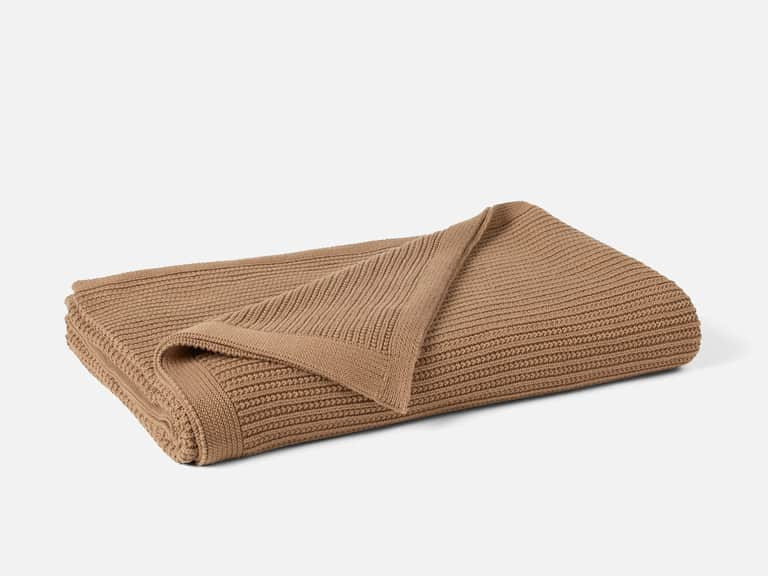
Ribbed structures create alternating raised and recessed lines. In garments, ribbing is often used where stretch and recovery are useful; in a throw, it contributes a visibly tactile surface and can lend the textile a sense of depth. The ridges may make a layer feel more substantial in the hand, while the valleys create shadow and contrast. The exact effect depends on the yarn and how tightly the fabric is knitted.
Seed stitch produces a small, regular texture, often with a pleasantly nubby character. Rather than relying on large ridges, it builds interest across the surface through alternating stitches. It can give a throw a more articulated look without requiring a bold motif. In a mixed or high-low pattern, areas of different stitch height add further variation: one section catches the light differently from another, making the fabric’s texture visible even from across a room.
A good example of this approach is the Linea Organic Knit Throw. Its construction combines ribbed seed stitch with a high-low knit pattern and a links-knit hem. Made from 100% organic cotton, it is described as soft and breathable, intended for layering over a sofa or at the foot of a bed. Its textured surface gives the throw visual dimension, while its organic-cotton composition offers a natural-fiber option for everyday home use.
Texture should not be mistaken for a guarantee of greater insulation. A raised stitch may feel inviting and create a more substantial hand, but warmth also depends on the textile’s overall weight and openness. A loosely knitted throw can allow more air to pass through than a compact one. A denser knit may sit more closely and feel warmer, though room temperature, clothing, and personal comfort remain part of the equation.
Why weight and openness matter
The spaces between stitches matter as much as the stitches themselves. Open construction can make a throw feel light and breathable, suited to mild weather or to someone who wants a cover without much weight. A tighter construction generally produces a more solid surface. It may feel warmer in use because it provides more coverage and limits air movement through the textile, though yarn and finished dimensions also make a difference.
Weight helps clarify how a cotton throw will behave over furniture. A light knit can fall softly over a chair or sofa and be easy to fold away. A heavier textile may settle more firmly across the body or furniture, but its weight can also put more strain on a stretchy structure when it is left hanging from one point. Neither quality is inherently better. The decision is about matching the textile to its role.
For a bed, a throw often serves as a top layer: a little extra coverage within reach, a visual finish, or a comfort layer for reading. On a sofa, it may be used frequently, folded, draped, and pulled into place. In those settings, a textile’s drape and ease of handling can matter as much as its warmth. A throw that is attractive but difficult to maintain may not suit a busy household as well as a more straightforward choice.
Cotton’s particular character
Cotton is valued in home textiles for its familiar, soft hand and breathable feel. It can work across seasons because it does not have the same heavy, insulating character as some thick wool or synthetic fleece layers. That does not mean all cotton throws feel cool: a dense knit, a substantial yarn, and a textured surface can make one feel comfortably cozy. The fiber sets a starting point; the construction shapes the experience.
Organic cotton refers to how the cotton is grown and certified, not to a single texture or level of warmth. A throw made from organic cotton may be smooth, nubby, airy, or weighty depending on its yarn and knit. If certification is important, look for the relevant details in the product information and consider what the certification covers. It is useful to separate claims about fiber sourcing from practical questions about feel, dimensions, and care.
For a household, comfort is also a matter of daily handling. A throw may be used for an evening on the sofa, folded over a bed, or carried from room to room. A breathable cotton knit can be appealing in these varied routines, but the specific care label remains decisive. Organic fiber does not make a knitted structure immune to stretching, shrinking, or changes in shape.
Care begins with respecting the loops
The central rule for caring for a knit throw is simple: avoid unnecessary force. Loops can shift when a textile is pulled, twisted, or lifted while wet. Before washing, check the manufacturer’s instructions for water temperature, cycle, drying method, and any restrictions. If the label recommends a gentle cycle, that guidance is especially relevant for a knit whose structure may stretch or change shape.
For the Linea Organic Knit Throw, the care instructions call for a cold wash on a gentle cycle with like colors, followed by tumble drying on low. The instructions also say to remove it promptly and note that a warm iron may be used if desired. Its product information cautions that the knit can stretch and that its size and shape may change over time. Those details are practical guidance, not a reason to avoid using the throw; they explain how to treat its construction with care.
A few habits help reduce avoidable strain:
- Use the care directions supplied for the particular throw instead of assuming every cotton knit can be washed the same way.
- Avoid pulling a wet knit from one edge. Support more of its weight when moving it, since water can make fabric heavier and more vulnerable to distortion.
- Remove a tumble-dried item promptly when the care label advises it, then arrange it neatly rather than leaving it compressed in the drum.
- Keep throws away from sharp hooks and rough surfaces that can catch yarn and draw a loop out of place.
- Store a knit folded on a shelf rather than hanging it for long periods, which can allow gravity to pull the fabric out of shape.
These steps are about preserving appearance and fit, not promising that a knit will remain unchanged forever. Natural fibers and looped constructions can respond to repeated washing and use. The important distinction is between normal, gradual change and preventable distortion caused by rough handling or unsuitable care.
A practical way to compare cotton throws
When comparing cotton throws, begin with intended use. A light layer for warm months has different requirements from a throw that will be used nightly on a cool sofa. Think about whether the piece needs to cover a person, add texture to a room, or do both. Dimensions matter: a smaller throw may be easier to fold and store, while a larger one offers more coverage and can carry more weight.
Next, read the construction description closely. Words such as ribbed, seed stitch, reversible, or high-low pattern describe aspects of the knit, but they do not by themselves establish warmth. Look for information about fiber content, overall feel, and whether the textile is designed for layering. If the available details do not state a weight, it is better not to infer one from a photograph or a stitch name.
Then consider maintenance. A machine-washable throw may fit more easily into a household’s routine, but the cycle and temperature still matter. A care label that warns of stretching deserves attention if the textile will be frequently moved or washed. The most suitable throw is not necessarily the one with the most elaborate pattern; it is the one whose feel, appearance, and upkeep make sense for the way it will be lived with.
Finally, consider how the knit will sit in the room. A textured surface can add depth to a plain sofa or bedding, while a more even stitch may provide a quieter finish. Color, scale, and texture work together. A heavily patterned or high-low knit can become a focal point; a subtle rib or seed stitch may blend into a calm, layered interior without disappearing entirely.
Shape, drape, and everyday use
A throw’s drape is the way it falls over a body or surface. Knits usually have more give than woven fabrics, which can make them feel relaxed and adaptable. That flexibility is part of their appeal: a throw can gather easily around the shoulders or settle into the contours of a chair. But drape is not the same as resilience. A flexible knit can still stretch, and it may not return to its original dimensions if it is repeatedly pulled or left suspended under its own weight.
For styling, folding rather than tightly rolling can help preserve the surface and make a throw easy to reach. When draping it over a sofa back, distribute the fabric instead of allowing the entire piece to hang from a narrow point. When placing it at the foot of a bed, avoid tugging the corners into a perfectly taut line; a natural fold often works better with the relaxed character of knitwear.
These are small choices, but textiles are shaped by ordinary routines. A throw that is moved often, washed frequently, or used by several people will experience more handling than one kept mainly as a decorative layer. Matching the construction to the demands of the home—and following the care directions—helps the fabric maintain its useful, lived-in character.
The quiet design of a well-chosen layer
A cotton throw occupies a modest place in a room, yet it changes how that room feels. Its stitch pattern brings relief to a flat surface. Its weight can make a sofa feel more inviting. Its color links bedding, upholstery, and other textiles. A good knit does these jobs without calling attention to the engineering behind it: loops, tension, yarn, and finishing become an object that is simply pleasant to reach for.
The most useful way to assess a throw is to look beyond the pattern name. Ask how the knit may affect texture and drape, whether the fabric seems suited to the desired season and use, and what the care instructions say about maintaining its shape. For organic cotton throws, consider certification and fiber details alongside the practicalities of cleaning and storage. No single stitch guarantees a certain level of warmth or durability; the full construction and the way it is handled matter together.
In the end, knit structure is a meeting point between design and daily life. Ribbing and seed stitch add dimension. Openness and weight help determine the character of the layer. Cotton brings a breathable, familiar feel, while the care label explains how to live with the fabric over time. Read those clues together, and choosing a throw becomes less about guessing from appearance—and more about finding a textile that belongs comfortably in the room and the routine.